
Learning from Lenin
Why we need his Erfurtianism today
We can’t take much from the work of Lenin after 1917 and apply it to what is to be done in Britain today. This shouldn’t be too controversial: we are not in a revolutionary situation.
This is a challenge to the expectations we might have when reading Lenin a hundred years after his death.
But although we are not in the position to take lessons from “Lenin the statesman”, we must follow “Lenin the party-builder”.
Lenin’s starting point in this regard was the minimum-maximum programme pioneered by Marx, Engels, and Kautsky, not a transitional programme of the kind later advanced by Trotsky.
Lenin the “Erfurtian”
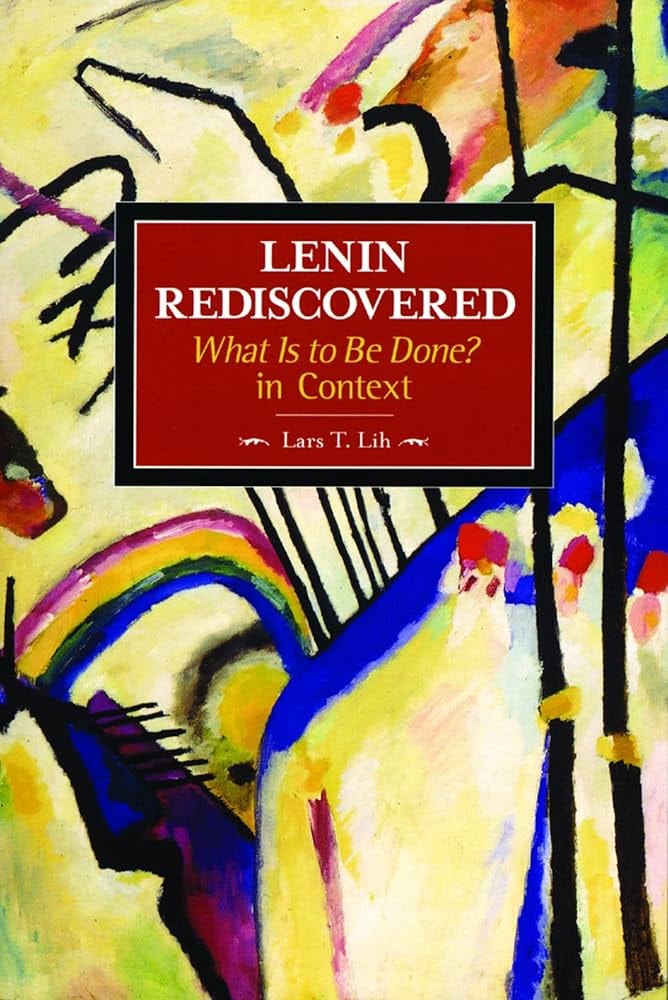
Lars T. Lih defines an Erfurtian as “someone who (a) accepts the SPD party that met at Erfurt as a model in both organisation and activity; (b) accepts the programme adopted by the Erfurt Congress as a model Social-Democratic programme; (c) accepts Kautsky’s commentary on the Erfurt Programme as authoritative.” [1]
In his book Lenin Rediscovered, Lih uses the following checklist to argue that Lenin’s writings show he was an Efurtian:
(i) Erfurt allegiance. An explicit acknowledgement of the three sources of authority: the party, the programme, Kautsky’s writings.
(ii) Merger formula. A commitment to the merger formula (‘Social Democracy is the merger of socialism and the worker movement’). This commitment shows itself in (a) the merger account of the origins of Social Democracy and (b) the two-front polemical war against those who refuse the merger.
(iii) Good news. A definition of Social Democracy’s mission as spreading the good news of the workers’ world-historical mission. This definition further implies (a) a political strategy aimed at bringing insight and organisation to the worker class; (b) a commitment to the ‘circles of awareness’ model of the labouring classes; (c) confidence that the workers will respond to the message.
(iv) Party ideal. An aspiration to establish an independent class-based political party. Such a party will have a clear commitment to the final goal of socialism, it will be centralised and disciplined, it will be as democratic as possible, and it will be organised on a nation-wide scale, making effective use of specialisation and division of labour, including full-time officials.
(v) Political freedom. An insistence on the urgent priority of achieving political freedom, which in Russia means overthrowing the autocracy.
(vi) Popular leadership. An expectation that the Social-Democratic Party will be able to become a party of the whole people.
(vii) Hegemony. A commitment to the hegemony strategy. Precisely because the first priority of the workers is to achieve socialism, they are the natural leaders in the national struggle for political freedom.
(viii) Internationalism. An aspiration to join and be worthy members of the international Social-Democratic movement. [2]
Lih’s book goes through the writings of Lenin in the years prior to the Russian Revolution to convincingly argue his case.
The reliance on the “renegade Kautsky” by Lenin might seem surprising in retrospect. However the orthodox Marxism of the 19th century succeeded in mass parties and trade unions throughout Europe.
Beyond social democracy
The starting point for Lenin was the orthodox Marxism of the Second International and its methods for building workers’ power. From the debate between Kautsky and Lenin over the Russian revolution amid its launch – and how the split in Social Democracy has been memorialised on the left – we can form an idealist rather than materialist conception of events and the conflict at stake.
Lenin was clear:
“The political form of a society wherein the proletariat is victorious in overthrowing the bourgeoisie will be a democratic republic which will more and more concentrate the forces of the proletariat of a given nation or nations, in the struggle against states that have not yet gone over to socialism.” [3]
It was the integration of rising new workers’ parties into the constitutional order of capitalist states which led to the political degeneration of social democracy, not the commitment to the creation of democratic republics and winning the battle of democracy against the bourgeoisie.
One telling of Lenin’s political development is that in the course of the struggle of the working class, the creation of workers’ councils demonstrated the form which proletarian democracy would take, rendering republicanism obsolete.
This is a narrative which will lets a group off the hook for not having an electoral strategy aimed at winning control of the bourgeois democratic institutions of representation within capitalist states – and sometimes for not even undertaking electoral intervention on the basis of taking the opportunity to put the group’s ideas to the wider working class, even if winning seats appears hopeless at first.
Taking the road to socialism from within a bourgeois democracy must involve the growing strength of the workers’ movement being matched in a revolutionary situation with a legislative majority opposed to the interests of the state-monopoly capitalist class. This is necessary to win the legitimacy of working class rule: a political majority of a new type.
Even if this conception is not expressed consciously and openly in theory within revolutionary circles today, it will emerge spontaneously in practice in response to the conditions of the class struggle if we are successful in building a new mass workers’ party capable of taking the path to power.
Citations
1. Lenin Rediscovered, p. 113
2. Ibid, pp. 113-4
3. “On the Slogan for a United States of Europe”, https://www.marxists.org/archive/lenin/works/1915/aug/23.htm